Blocking When Mounting Drapes

To begin, though, let’s consider this theoretically. Since we aren’t all engineers or construction science specialists, let’s ask the question "what is blocking?" in layman’s terms.
Blocking is support within a wall or ceiling that holds heavy items. Think about hanging a picture or shelf in your home or apartment. When you get ready to insert the nail, what are you hoping to hit on the other side of the drywall? A stud, because a stud will hold the weight of the picture or shelf. The stud, while being specific to walls, acts as the blocking. It fits our definition of ‘support within a wall' (in this case) that holds a heavy item, although continuous blocking is required for drapery treatments, due to our 24" support requirement. This is to say that when installing into a wall, we do not simply go and find the studs. We must support drapery track every 24" regardless of studs and therefore continuous blocking should be in place directly behind the sheet rock.
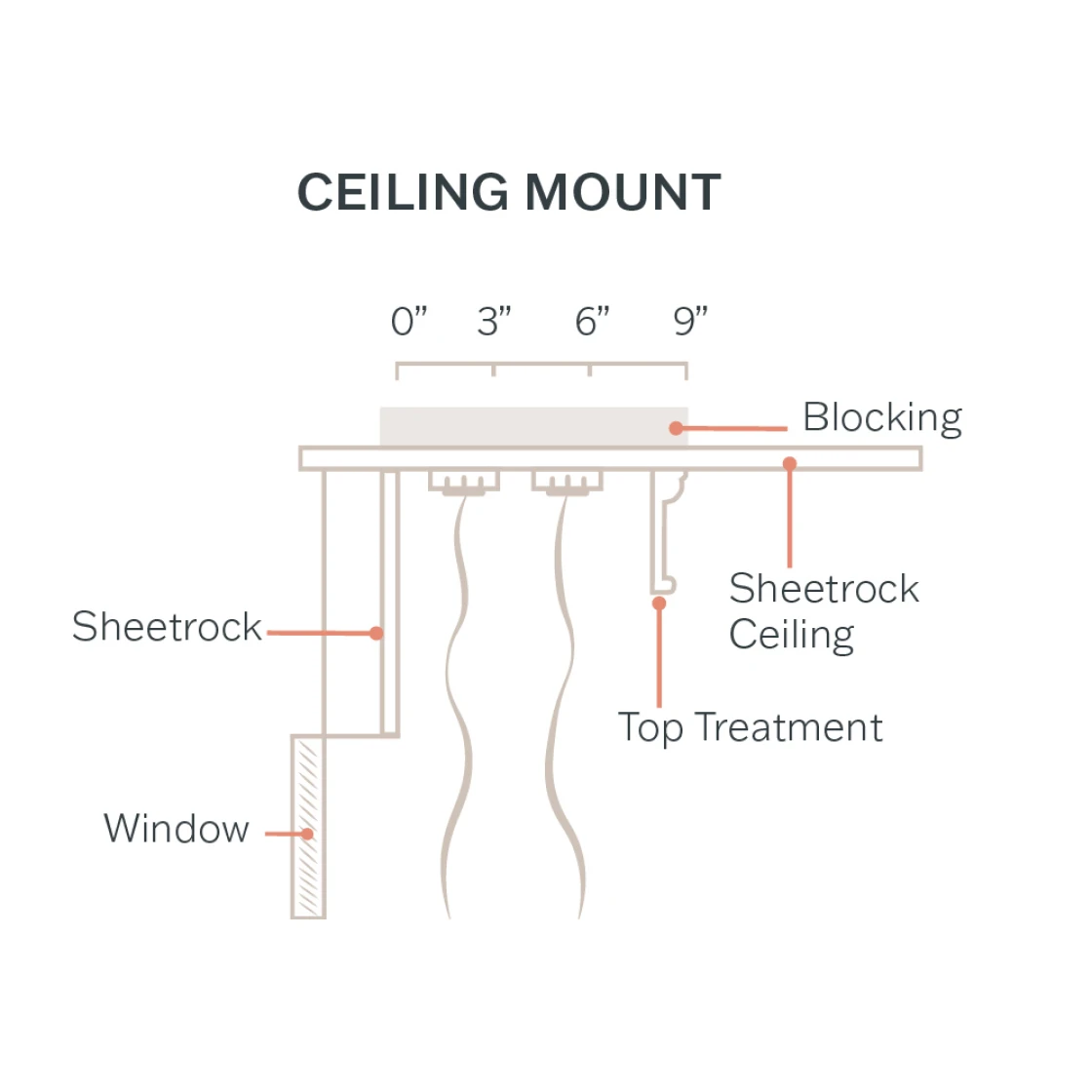
The majority of drapery hardware is installed in the ceiling. While studs are always in walls no matter what you are building, ceiling blocking cannot be taken for granted as a standard practice in the construction of a ceiling. So what do you do? If you were to install drapery hardware into the ceiling without blocking it would pull straight through the sheet rock. Therefore the need of good blocking is a must to guarantee guest safety.
Ceiling blocking needs to be installed wherever drapery track will be installed. The blocking needs to be at least a 3/8" thick located directly behind the ceiling surface. It needs to span the width of the widest treatment, and needs to have a depth from window wall out into the room corresponding with the furthest treatment from the window wall. The depth of the blocking is an important point to note and can be confusing. The key to remembering is multiples of 3. All drapery treatments must be 3” apart. If you add up the number of treatments you will have in a specific room (over drape – 1, sheer – 2, cornice – 3) and multiple by 3 you will solve for the distance from window wall where the furthest treatment will be installed and therefore solve for the depth that blocking is needed (9" for 3 treatments). See the image above for details of the depth of blocking and read our blog “How Much Space Needs to Exist Between Treatments?” for a better understanding of why there is so much spacing between treatments.
When Mounting Shades

For an inside mounted roller shade, the blocking will need to be above and level with the window, inside the window frame.

Outside mounting will require blocking above the window and in the ceiling to mount a roller shade outside of the window frame.
Remember the Studs

With the growing popularity of metal framing or metal studs being used for both walls and ceilings it is very important to note that this is NOT considered adequate blocking for drapery due to the lack of substance for the screws to grip (see image).
It should also be noted that if renovation entails placing drapery in areas where old/existing drapery had not been previously, a drapery project manager may ask that blocking be added or it's existence confirmed prior to install.
Ready to put this into practice? Download the printable reference card below to keep these essentials close at hand, and come back soon for more tips, techniques, and inspiration from Threadwell.